Mechanical Symmetry
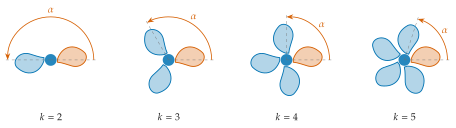
Mechanical symmetry is the name given to the property of keeping a constant moment of inertia as a structural section rotates.
A square, an equilateral triangle, a hexagon, five bars around a column: they bend and vibrate the same in every direction. This page presents the idea, what the second edition of the book adds, and the programs behind it.
The idea
In sections with this symmetry, the moment of inertia can be calculated using specific formulas, simplifying certain calculations.
The constancy of the moment of inertia facilitates calculations and ensures uniform deformation values under bending.
A section with mechanical symmetry deforms or vibrates identically in any direction, regardless of the position of the loads or the orientation of the element.
The simplest way to get it: any section with rotational symmetry of order three or more has it. The circle is the best-known example, but the equilateral triangle, the square or five bars around a column behave like a circle as far as the moment of inertia is concerned.
What the second edition adds
The first edition ended with a chapter called No Answers. Fourteen years of intermittent work, and a long dialogue with an AI assistant for the last stretch, produced these answers. Every number that is not a textbook formula was recomputed by a program.
Not only symmetric shapes
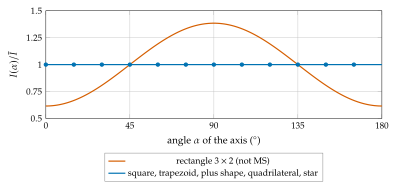
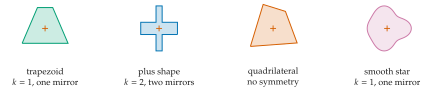
Rotational symmetry of order three or more guarantees mechanical symmetry, but it is not the only way. An isosceles trapezoid with the right proportions, a cross-shaped section, a quadrilateral with no symmetry at all and a smooth star all have a constant moment of inertia, tuned by their dimensions.
The first edition's Theorem 3.7 stated that rotational symmetry is also necessary. The second edition extends it and explains why these exceptions exist.
A practical use
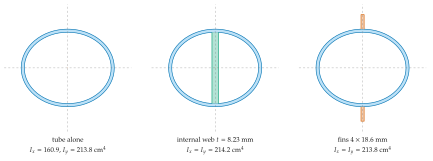
An elliptical tube is much stiffer in one direction than in the other. Adding material along its weak axis equalises the two directions: on a 120 × 100 × 4 mm steel tube, an internal web 8.23 mm thick, or two outer fins of 4 × 18.6 mm, give the same moment of inertia about both axes.
Three dimensions
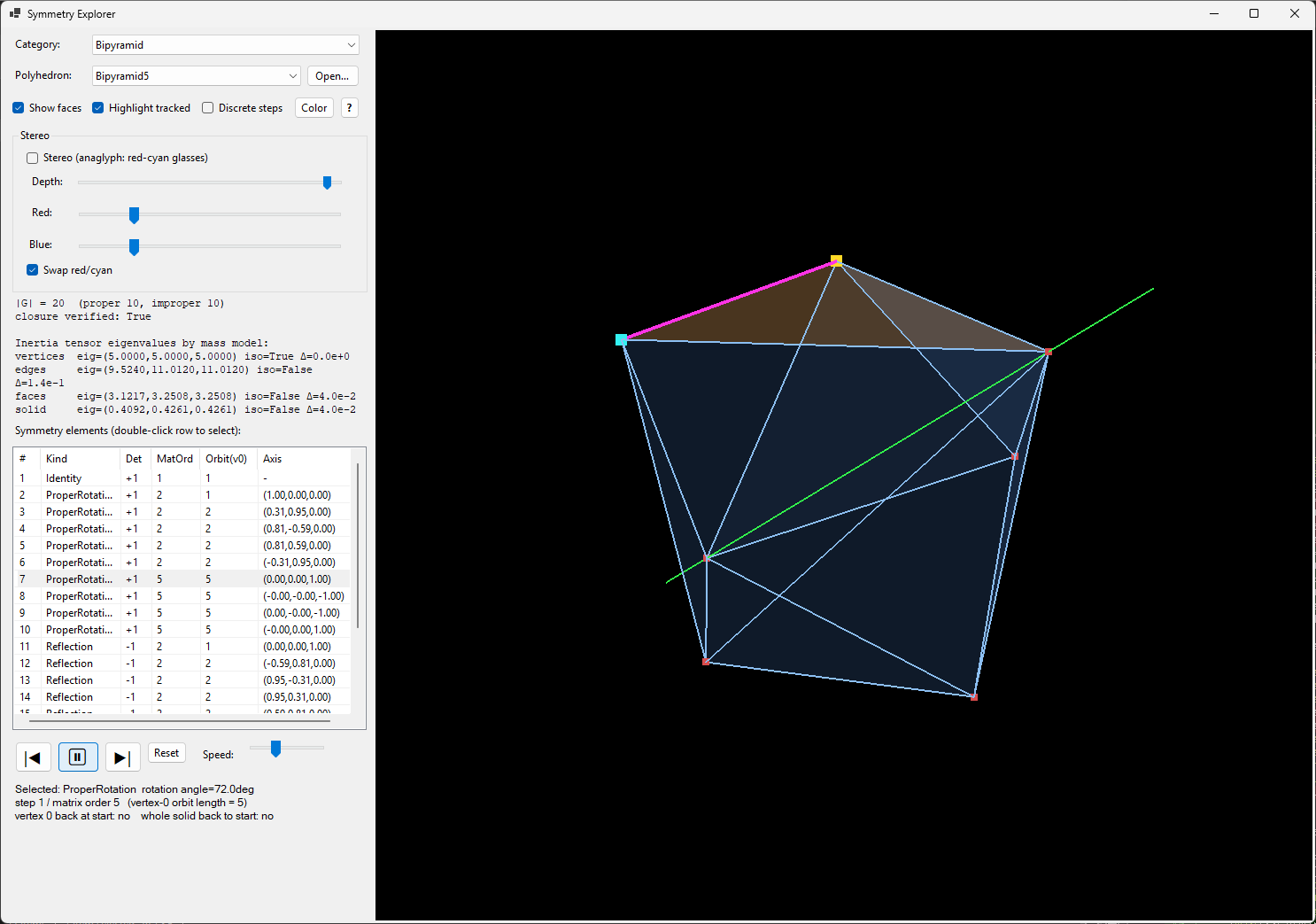
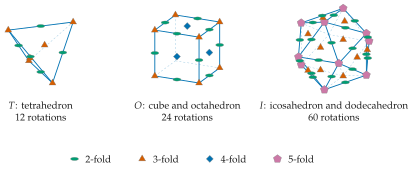
In space the moment of inertia of a body is a tensor, and mechanical symmetry means that it is a multiple of the identity: the same value about every axis through the centre. Any body with the symmetry of the tetrahedron, the cube or the icosahedron has it, whatever its shape or mass distribution, and no other rotation group can do it.
So, unlike in the plane, there is a ceiling: rotations of order five.
An appendix gives the exact moments of inertia and radii of gyration of the five Platonic, the 13 Archimedean and the 13 Catalan solids, in four mass models (vertices, edges, faces and solid). All 31 solids are exactly isotropic.
Points on a sphere
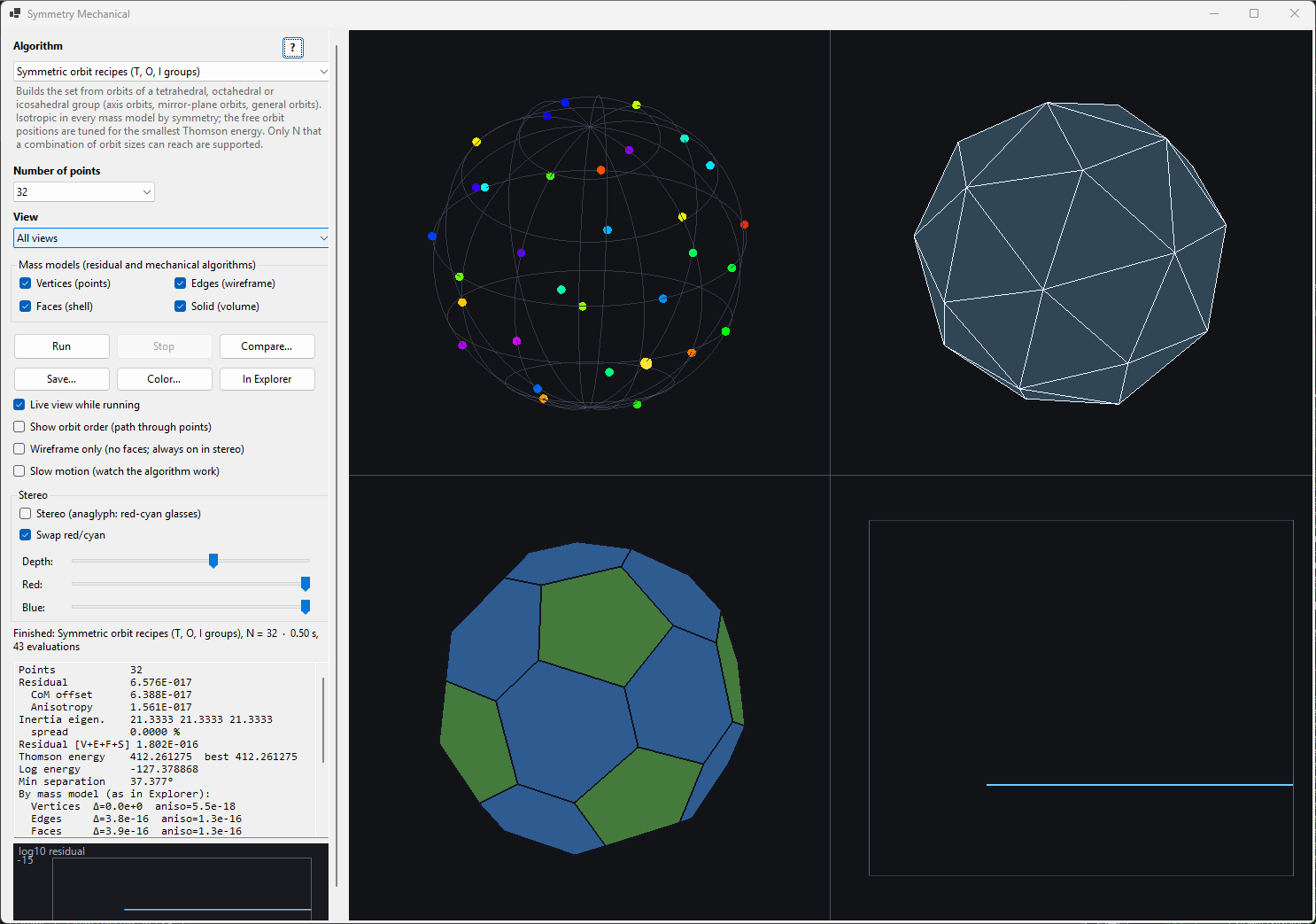
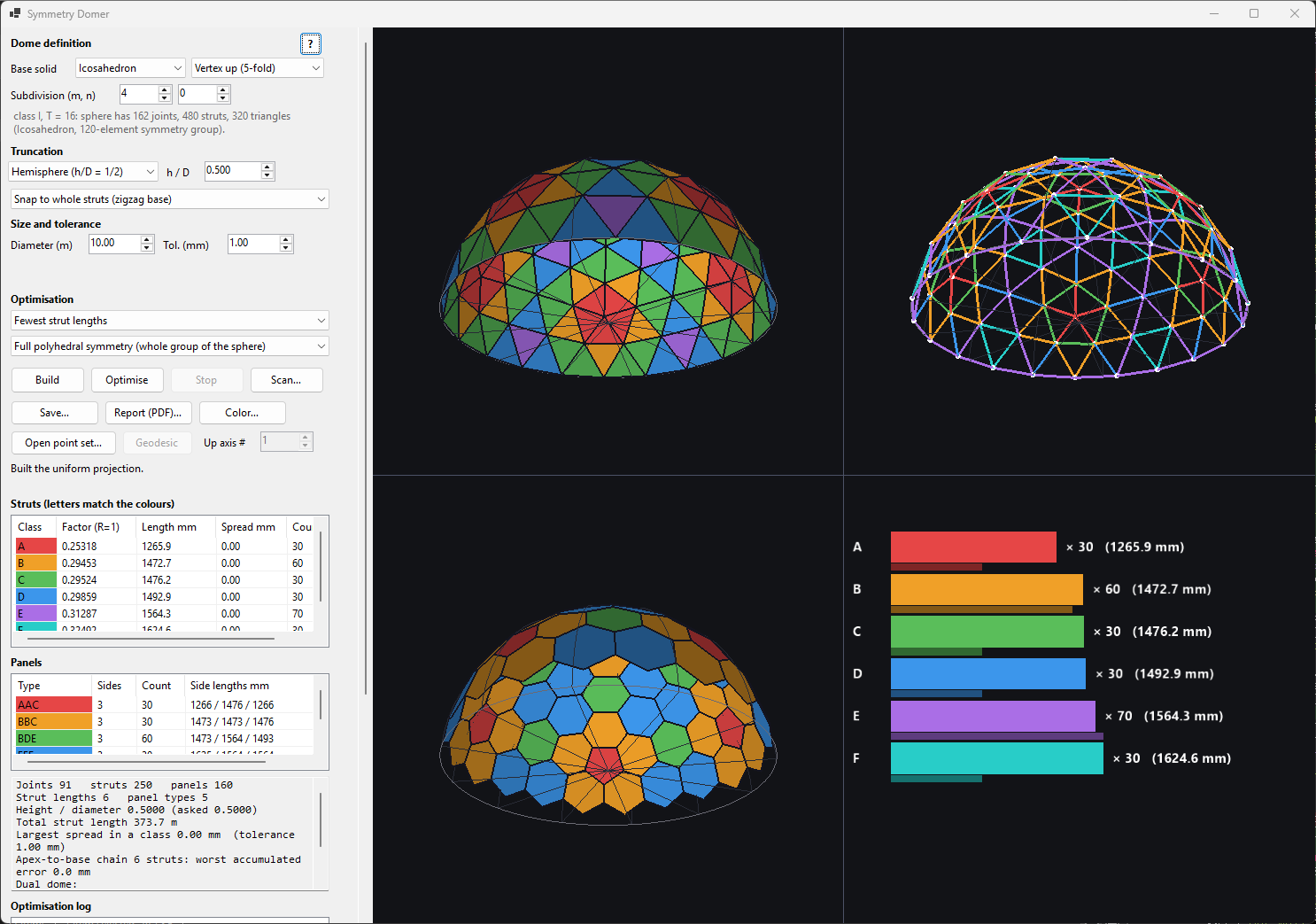
N equal masses on a sphere have an isotropic inertia tensor exactly when they form a spherical 2-design. That ties the problem to Thomson's problem of electrons on a sphere, to Smale's seventh problem and to geodesic domes.
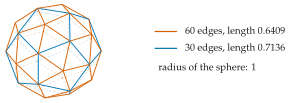
The picture shows 32 points, the vertices of an icosahedron and of its dual dodecahedron: a Thomson minimum with only two different edge lengths. Symmetry makes isotropy free; without it, a set needs about as many different edge lengths as points.
Thomson's energy is a sum over all the multipoles of the points, and isotropy asks only one of them, the quadrupole, to vanish: that is why the minima are isotropic only when their symmetry forces it.
Equal pyramids, and a paradox
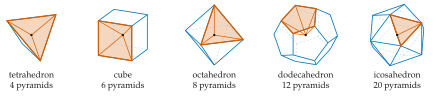
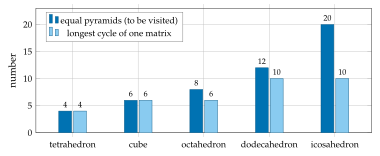
Cut a Platonic solid into equal pyramids from its centre: there can be 4, 6, 8, 12 or 20. One matrix can run through all of them only for 4 and 6; for 8, 12 and 20 it cannot. The icosahedral group is also the smallest non-solvable group, the door to Klein's solution of the quintic equation.
The book
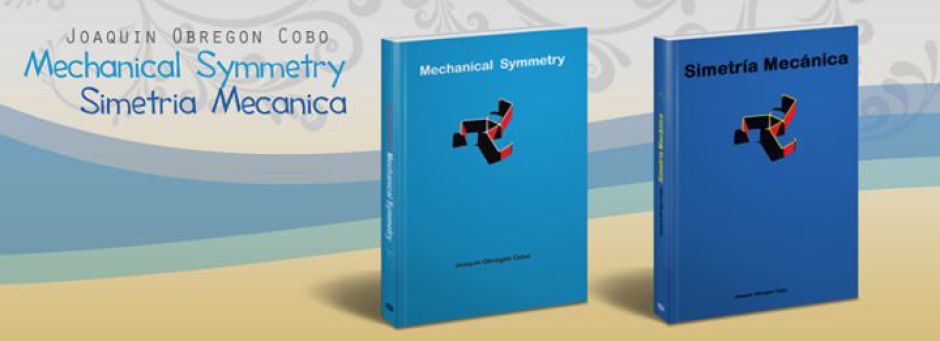
Mechanical Symmetry
Revised and extended, A4, in colour. English and Spanish editions, as PDF.
- Introduction
- Questions and known answers
- New answers: mechanical symmetry
- Open questions
- Challenging questions
- A. Moment of inertia of any polygon
- B. Corrections to the first edition
- C. Moments of inertia of the Platonic, Archimedean and Catalan solids
- D. Formulas for mechanically symmetric sections
Why a book
This book has been conceived and written to introduce a new concept: Mechanical Symmetry.
Readers can download content from the internet, including documents for teachers and students, which interactively help explain and understand concepts related to the Moment of Inertia and Mechanical Symmetry. Some additional extras are also available.
Publications ExtrasFor owners of the first edition. Theorem 3.7 of the first edition, which said that a section has a constant moment of inertia if and only if it has rotational symmetry of order three or more, is extended in the second edition: other sections, tuned by their dimensions, have the property too. The extended statement and the other corrections, including those of the formula compilation (chapter 6), are listed in Appendix B of the second edition, and the corrected formulas are back as Appendix D.
Programs
The results of the second edition were found and checked with three programs. Their help pages (in English) explain what each one does.